

Introduction
Imagine this: In 2026, almost every health insurance company in the United States is using artificial intelligence. A recent survey found that 94% of health plans have adopted AI in some form. But here is the surprising part. Only 21% of members actually use AI tools themselves. That is a big gap. So what is going on?
We are living through a huge shift in how AI healthcare tools are changing the way insurers work. The push is real. Health plans are using AI to cut costs, speed up claim processing, and spot fraud. A survey by NVIDIA shows that AI is already delivering a clear return on investment across many healthcare areas. Meanwhile, 75% of U.S. health systems now use at least one AI application, up from 59% just one year earlier.
But not everything is smooth. Private health insurance companies face pressure to keep premiums low while improving member experience. Medicare supplement plans and other senior-focused programs have their own challenges, like managing complex chronic conditions and making sure older adults get timely care. And then there is the trust issue. A 2024 American Medical Association survey found that 61% of physicians worry about AI in healthcare. That concern matters a lot because doctors are the ones who will work alongside these tools.
So where does that leave us? This article gives you a data-driven overview of how AI is being used in health insurance right now.

We will look at real world applications, the rules and regulations that shape this space, and how to pick the right AI vendor for your organization. Whether you work at a major insurer, run a healthtech startup, or advise health systems, you need to understand these trends to stay ahead.
For a closer look at how technology is changing care delivery, check out our article on innovative primary care tech models reshaping senior care in 2026. It shows how AI fits into broader efforts to improve outcomes for older adults.
Let us dive into the numbers, the risks, and the opportunities that define AI in healthcare today.
The Current Landscape of AI in Health Insurance Administration
Health insurance administration is expensive. Between processing claims, catching fraud, and answering member calls, costs add up fast. That is why AI healthcare has become a top priority for insurers. According to a HealthEdge survey from early 2026, 94% of health plans have already adopted some form of AI.
The goal is simple: cut costs and improve service. And it is working. A new survey from NVIDIA confirms that AI is delivering clear return on investment across many healthcare areas, especially in administration.
But not all insurers are moving at the same speed. Medicare Advantage plans are leading the way. They have more freedom under federal rules to test new AI tools. Meanwhile, medicare supplement plans and other private health insurance products often move slower because of stricter regulations. Still, organizations like Molina Healthcare and Sentara Health Plans are exploring AI to improve how they serve members. The Guidehouse 2026 healthcare AI trends report shows that plans are aligning their people, processes, and data to make AI successful.
So what are insurers actually doing with AI? Three use cases dominate:
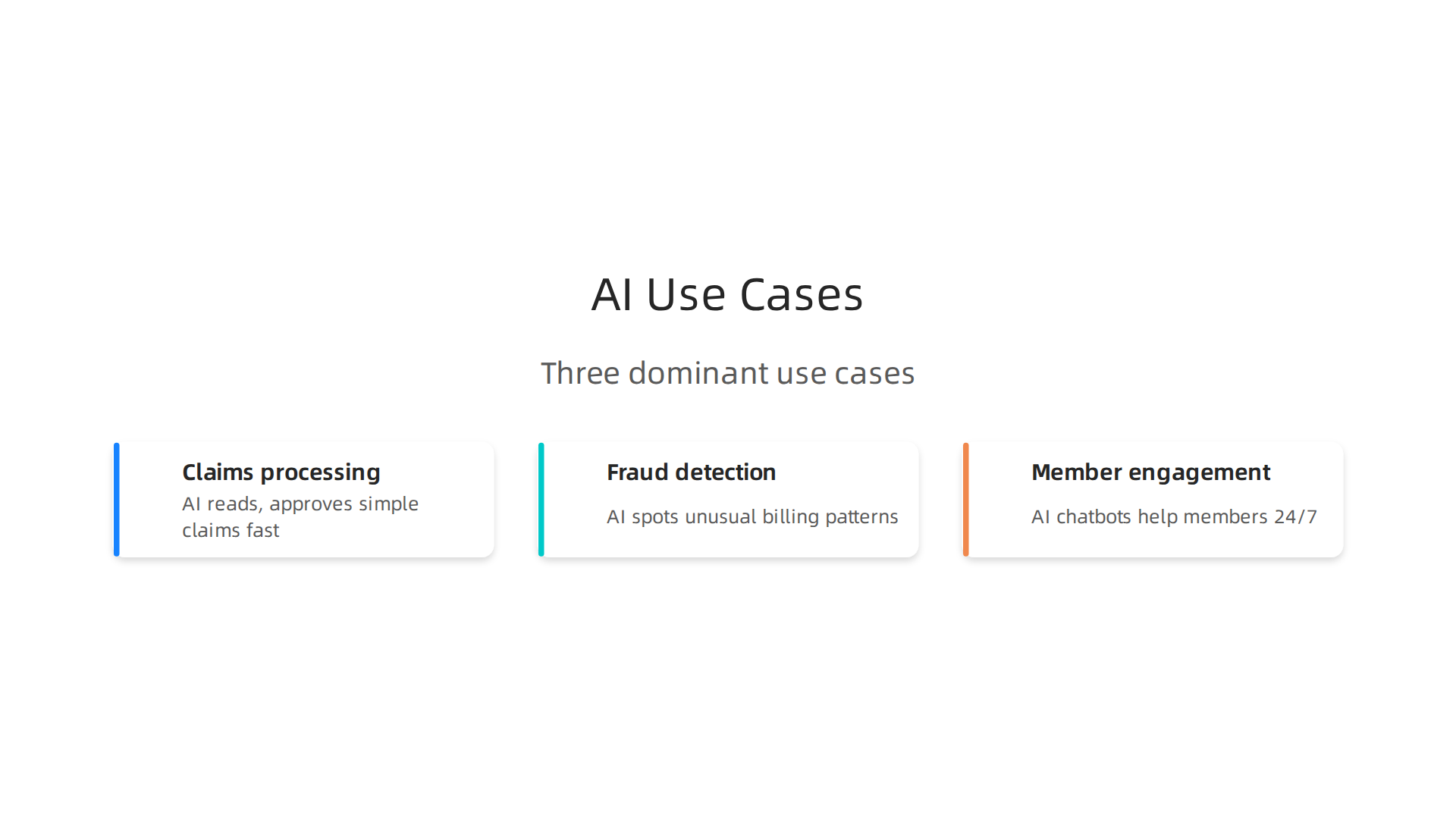
- Claims processing. AI reads and approves simple claims in seconds, cutting down delays.
- Fraud detection. AI spots unusual billing patterns that humans might miss, saving millions.
- Member engagement. AI chatbots help members find doctors, check benefits, and get answers 24/7.
A study published in PMC highlights that health systems are already seeing real wins with generative AI in these areas.
For a deeper look at how AI is improving care for seniors and people with chronic conditions, check out our article on innovative clinical care tech that improves outcomes for palliative and dementia patients. It connects administrative AI with real patient outcomes.
Even with all this progress, there is a big gap. Only 21% of health plan members actually use AI tools, according to the same HealthEdge survey. That means insurers need to build trust and improve the user experience. The next section will explore how to close that gap.
Automating Claims Processing and Prior Authorization with AI
So we know AI is widely adopted in health insurance. But where does it actually make the biggest difference? Two areas stand out in 2026: claims processing and prior authorization. These are the parts of health admin that frustrate everyone the most. Patients wait forever for answers. Doctors spend hours on paperwork. Insurers burn cash on manual reviews.
AI fixes both problems.
Let us start with claims processing. Traditional claims review takes days. A human reads every line. But AI healthcare tools use natural language processing to understand claims in seconds. The system checks the patient’s coverage, verifies the procedure code, and approves it or sends it for review automatically. One study found that AI reduced claims processing time by 40% and improved fraud detection accuracy by 30%. For private health insurance companies that process millions of claims each month, this is a massive win.
Now for prior authorization. This is the approval your doctor needs before they can perform a procedure or prescribe a specific treatment. Right now, it is one of the most broken parts of healthcare. It causes treatment delays and burns out doctors.
AI changes this. Instead of a nurse calling the insurance company and waiting on hold, the AI checks the medical guidelines and the patient’s history in real time. It can approve routine requests instantly. This dramatically improves provider satisfaction and reduces administrative burden. When your doctor spends less time on the phone, they spend more time with you.
This is especially important for people with medicare supplement plans. Seniors often need quick access to specialists, medical equipment, or advanced imaging. Prior authorization delays can be dangerous. For a closer look at how these technologies are helping seniors directly, read our piece on innovative primary care tech and models reshaping senior care in 2026.
Here is the real challenge though. Integration with existing Electronic Health Record systems is hard. Insurers like Molina Healthcare and Sentara Health Plans have to connect AI software to old databases that were not built for this. The data is messy. It lives in different formats. If the AI cannot pull the right patient record, it cannot do its job.
That is why successful AI healthcare projects in 2026 require strong data strategy. You cannot just buy a tool and hope it works. You need to clean your data, map your workflows, and choose vendors that specialize in seamless EHR integration. The ROI is real, but it only comes when the foundation is right.
AI also does not just speed up good claims. It catches bad ones too. By automating the initial triage of claims, AI can flag suspicious patterns or billing errors before money leaves the door. This saves insurers millions every year.
The bottom line is this. Automating claims and prior authorization with AI reduces costs, improves satisfaction, and gets patients the care they need faster. But technology alone is not enough. The next step is getting members to trust and use these tools. We will cover that next.
AI for Fraud Detection and Risk Management in Medicare Advantage
So we just saw how AI speeds up claims and prior authorization. But there is another huge win for health plans in 2026. AI also helps catch fraud and manage risk. This matters a lot for Medicare Advantage plans.
Why Medicare Advantage? These plans care for older adults with complex health needs. The billing is complicated. There are many different services, providers, and payment models. That complexity opens the door for fraud, waste, and abuse. Some providers bill for services they never gave. Others upcode or charge for unnecessary tests. All of that costs the system billions every year.
Here is where machine learning steps in. AI models look at every claim as it comes in. They compare it to normal patterns. If something looks off a sudden spike in physical therapy claims from one clinic, or a code that does not match the patient’s condition the system flags it in real time. This works much faster than a human auditor. One study found that AI boosted fraud detection accuracy by 30% while cutting processing time by 40%. For Medicare Advantage plans processing thousands of claims daily, that is a game changer.
AI does not just catch bad claims after they are paid. It can stop them before money leaves the door. Modern AI agents review claims at the front end. They look for mismatched codes, duplicate billing, and provider anomalies. This approach saves insurers millions each year and keeps premiums lower for members.
Another big area is risk adjustment. Medicare Advantage plans get paid based on the health risk scores of their members. If those scores are wrong, the plan gets underpaid or overpaid by the government. Both are bad. AI helps here too. It scans medical records and claims to find missing diagnosis codes. It makes sure the risk score matches the true health of the member. This improves accuracy and keeps the plan compliant with CMS rules.
Of course, doing this well requires good data and the right tools. Insurers need to connect AI software to their existing systems. Many plans work with partners like Molina Healthcare or Sentara Health Plans to make that happen. Choosing the right platform is key. For a deeper look at how technology helps seniors directly, check out our article on innovative primary care tech and models reshaping senior care in 2026.
The bottom line is simple. AI makes fraud detection faster and more accurate. It also helps health plans manage risk better. That means lower costs and fairer payments for everyone.
Enhancing Member Experience with AI-Powered Personalization
We just talked about how AI catches fraud and manages risk behind the scenes. But there is another side of AI your members actually see and feel. In 2026, AI is transforming the member experience in ways that make health plans more helpful, faster, and more personal.
Think about the last time you tried to get a simple answer from your health plan. Maybe you called and waited on hold. Or you searched a website for twenty minutes. That is frustrating. Now imagine this instead: a member wakes up at 2 AM wondering if their doctor is in network. They open their phone, type the question into a chat, and get an answer in seconds. That is the power of AI chatbots and virtual assistants.

Today, AI chatbots handle high-volume, low-complexity questions like "What’s my deductible?" or "Is Dr. Singh in network?" quickly and accurately. According to a 2026 industry report, chatbots and voice agents now answer these routine questions around the clock, freeing human staff for more complex needs. This matters a lot for Medicare Advantage members who may have trouble navigating complex plan details on their own. And it works: 92% of businesses report better customer satisfaction after adding AI chatbots.
But AI does more than answer questions. It learns about each member over time. A good AI system can recommend a personalized plan during open enrollment. It can send health tips based on your chronic conditions or remind you about a free preventive screening you are due for. This kind of personalization makes members feel valued and understood. It also helps health plans keep members engaged and healthy.
Here is where predictive models come in. AI looks at claims data, lab results, and even past behaviors to spot members who might need extra help. For example, a member with diabetes who has not refilled their medication in two months might get a call from a health coach. Or someone who just left the hospital might receive a follow-up reminder to see their primary care doctor. This proactive outreach reduces costly emergency visits and improves outcomes. Health plans like Molina Healthcare and Sentara Health Plans are already using these tools to better support their members.
The same AI that powers personalization for Medicare Advantage also works for private health insurance and Medicare supplement plans. Any plan that wants to deliver a modern, member-friendly experience can benefit.
For a deeper look at how technology is reshaping care for older adults, check out our article on innovative primary care tech and models reshaping senior care in 2026.
The bottom line: ai healthcare is not just about back-end savings. It is about making every interaction with your plan easier, smarter, and more personal. When members feel like their plan truly knows them, they stay happier and healthier. And that is a win for everyone.
Predictive Analytics for Population Health Management
AI doesn’t just react to member questions. In 2026, it also predicts what might happen next. This is a game changer for population health management.
Think about a member with diabetes who has not picked up their medication in a month. Without AI, that might go unnoticed until they end up in the emergency room. But with AI, health plans can spot that person early. They can reach out with a reminder or a call from a health coach. This kind of early intervention keeps people healthier and saves money. The same applies to members with heart disease or asthma. AI looks at claims data, lab results, and even past behavior to find patterns humans would miss. According to industry analysis, AI is transforming health insurance by making these predictions possible [cite ericjansinsurance].
But there is more. To make predictions even better, health plans now add social determinants of health data. This includes things like whether a member has reliable transportation, stable housing, or access to healthy food. If someone misses a lot of appointments, the real reason might be they have no way to get to the doctor. By including this data, AI gets a fuller picture. It can then recommend the right kind of help, like a ride service or a home visit. Insurers like Molina Healthcare and Sentara Health Plans are already using this approach to improve outcomes.
Population health dashboards make it all visible. These AI powered dashboards show risk levels across the entire membership.

A manager can see at a glance which members need immediate attention and which are doing well. This helps insurers manage risk better, especially for private health insurance and medicare supplement plans. Instead of reacting to problems after they happen, plans can act early.
The result is a smarter, more proactive ai healthcare system. Members get help before they get worse. Plans reduce costly emergency visits. And everyone benefits from a system that truly cares about prevention. For a deeper look at how technology innovations are improving care for complex conditions, read our article on clinical care technology innovations that drive better outcomes in palliative and dementia care.
The bottom line: when AI can predict who needs help before they ask for it, everyone wins. Your plan becomes more efficient, your members stay healthier, and the whole system works better.
Navigating Regulatory Compliance for AI in Health Insurance
All this AI power sounds great, right? But here is the thing. Using AI in health insurance also comes with serious responsibility. You cannot just plug in a tool and walk away. In 2026, regulators are paying close attention. If you handle protected health information (PHI) the wrong way, the fines can be huge. And the rules keep changing. According to a recent compliance guide, healthcare providers and insurers must follow a growing list of requirements from agencies like the Joint Commission and state lawmakers [cite jimersonfirm]. That means every part of your ai healthcare system needs a compliance plan from day one.
Let us break down the three biggest rules you need to know.
-
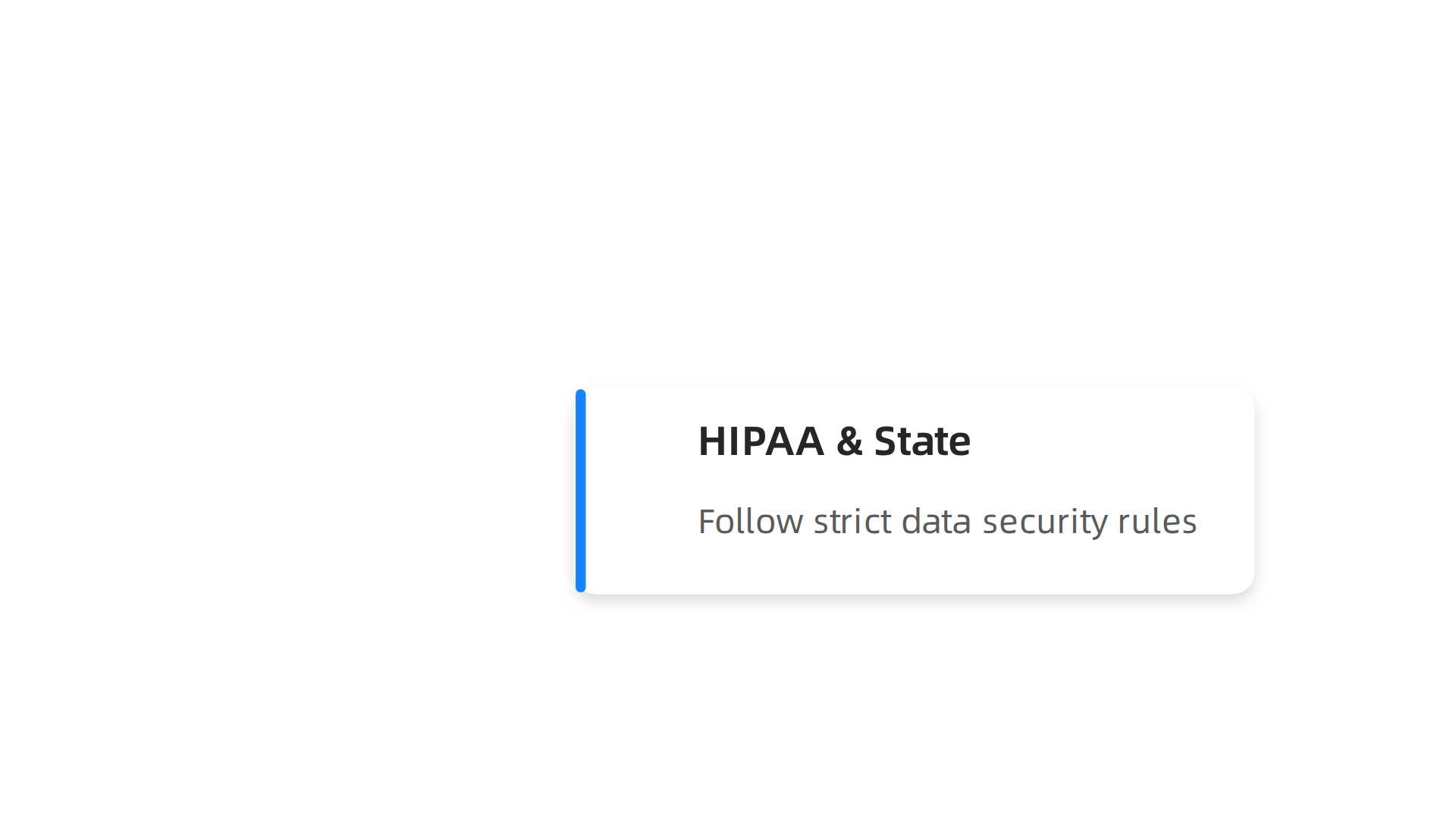
HIPAA and state privacy laws: AI tools that touch PHI must follow strict privacy and security rules. This includes things like de-identifying data, limiting who can access it, and getting patient consent. Many states now have their own AI laws too. As of 2026, 47 states have introduced over 250 healthcare AI bills [cite getsolum]. So if you offer private health insurance in multiple states, you need to track each one. The healthcare regulatory landscape in 2026 is complex, with HIPAA, FHIR, and prior authorization controls all affecting AI compliance [cite accountablehq].
-
CMS guidelines for Medicare Advantage plans: If you run Medicare supplement plans, you have extra rules from the Centers for Medicare and Medicaid Services. CMS launched the WISeR program in 2026 to oversee AI use in Medicare Advantage. They want to ensure algorithms do not discriminate or deny care unfairly. You must prove your AI tools are accurate and unbiased. This is a big shift. For more on how technology is reshaping senior care, check out our article on innovative primary care technology models designed for senior populations.
-
FDA oversight for clinical decision tools: Some AI tools go beyond admin work. If your system makes clinical decisions, like recommending a treatment or flagging a diagnosis, the FDA may regulate it as a medical device. A 2026 guide on generative AI regulations explains that FDA, HIPAA, and FTC rules all overlap when AI affects patient care
[cite nixonlawgroup]. You need to know which category your tool falls into.
So what does this mean for you? Compliance does not have to be a burden. Think of it as a way to protect your members and your reputation. By following the rules now, you avoid problems later. And you build trust with the people you serve. That trust is the real foundation of any successful ai healthcare system.
Once you understand the compliance rules, it is time to pick the right partner for your ai healthcare journey. Not every vendor is ready for the unique demands of health insurance. In 2026, the market is full of options, but choosing the wrong one can cost you time and trust. So how do you separate the best from the rest?
Here are the key things to look for when evaluating an AI vendor.
-
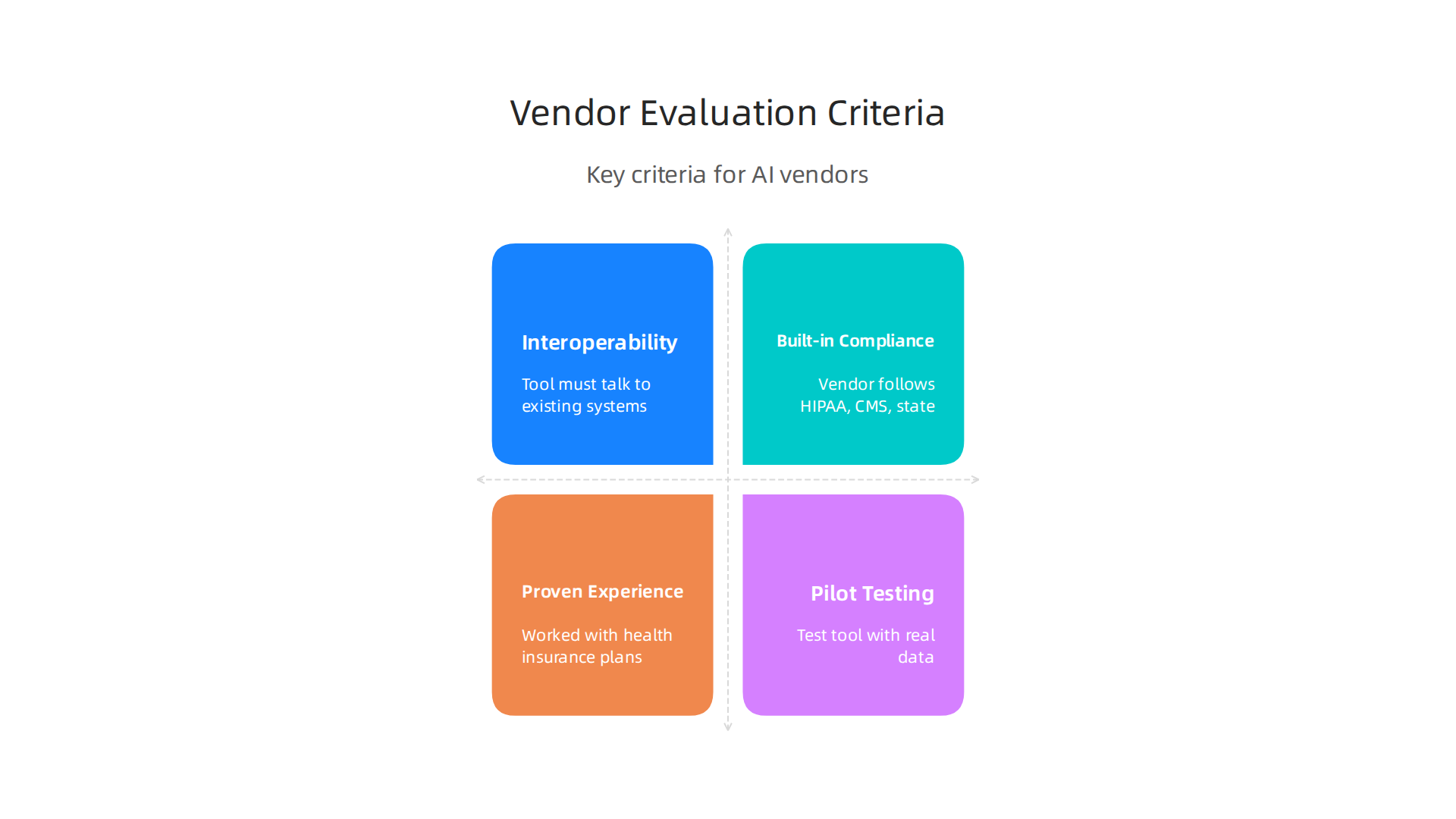
Interoperability first. Your AI tool needs to talk to your existing systems. That means it should work with your electronic health records, claims platforms, and billing software without a headache. A 2026 trends report explains that AI is becoming core clinical infrastructure, and seamless EHR integration is a must [cite healthjobsnationwide]. If the vendor cannot show you a clean integration plan, keep looking.
-
Built-in compliance and transparency. This one ties right back to those regulatory rules we just covered. Your vendor should already be following HIPAA, state privacy laws, and CMS guidelines. Ask them directly how they handle protected health information and how they keep their algorithms fair. The 2026 guide to generative AI regulations stresses that FDA, HIPAA, and FTC rules overlap when AI affects patient care [cite nixonlawgroup]. A vendor that cannot explain their compliance posture in plain terms is not worth the risk. For more on how senior-focused plans are adapting, read our piece on innovative primary care technology models designed for senior populations.
-
Proven experience in health insurance and Medicare plans. Some vendors build tools for hospitals or clinics, but health insurance is a different beast. Look for vendors who have worked with private health insurance plans, Medicare supplement plans, or organizations like Molina Healthcare and Sentara Health Plans. They understand prior authorization, claims processing, and member outreach. A vendor that has already handled those workflows will save you from costly missteps.
-
Pilot before you commit. No matter how good a vendor looks on paper, you need to test their tool with your real data. Run a small pilot with a specific use case, like prior authorization turnaround or fraud detection. See how it performs with your members. The 2026 guide to AI implementation strategies recommends starting with controlled pilots to measure accuracy and impact [cite healthjobsnationwide]. This step keeps you from deploying a system that does not actually work in your environment.
Take your time with vendor selection. Ask tough questions. Look at case studies from other health plans. And always run a pilot. The right vendor will be happy to prove their value before you sign a long contract.
Future Trends: What’s Next for AI in Health Insurance?
You have chosen a solid vendor and started your pilot. But the real excitement lies ahead. The world of ai healthcare is moving fast, and health insurance plans need to keep up.

So what does the next few years look like for private health insurance, Medicare plans, and the companies that run them?
Here are three big trends to watch in 2026 and beyond.
Generative AI changes how members experience their plan
Generative AI is already making member interactions smoother and more personal. Instead of reading a long PDF about your benefits, a member can ask a simple question and get a clear answer in seconds. And on the back end, generative AI helps with clinical documentation, prior authorization letters, and care summaries. The 2026 insights from Wolters Kluwer show that generative AI is becoming a key tool for improving both member satisfaction and provider workflows [cite wolterskluwer]. Plans that use this technology will stand out in a crowded market.
Real time data from wearables and IoT makes risk models smarter
Your Fitbit, smart watch, or glucose monitor collects data every second. Soon, health plans will use that real time data to update risk models on the fly. Instead of relying on claims data from months ago, an AI system can see that a member’s activity dropped suddenly and flag a potential health issue early. This shift is part of a larger move toward what HIMSS calls "AI agents" that analyze complex data across entire health ecosystems [cite himss]. For Molina Healthcare, Sentara Health Plans, and other insurers, this means more accurate pricing and better preventive care.
Regulations will shape how fast AI gets adopted
You already know compliance is critical. As AI tools become more powerful, state and federal rules will keep evolving. The same Wolters Kluwer report highlights that governance frameworks are still catching up to the technology [cite wolterskuwer]. Plans that invest in transparent, explainable AI now will have a head start when new rules arrive. And with physician use of AI jumping from 38% in 2023 to 72% in 2026, the pressure to get it right is real [cite youtube]. For health plans serving Medicare supplement plans and older populations, these regulatory shifts matter even more. You can read more about how senior focused plans are adapting in our article on innovative primary care technology models designed for senior populations.
The market for AI in healthcare is projected to grow from $21.66 billion in 2025 to $110.61 billion by 2030 [cite marketsandmarkets]. That growth will reshape how health insurers work, compete, and care for members. The plans that start preparing today will be the ones leading tomorrow.
Summary
This article offers a data-driven look at how artificial intelligence is reshaping health insurance administration in 2026, from claims and prior authorization to fraud detection, member engagement, and population health. It explains why nearly all health plans have adopted some form of AI (94%) while member-facing use remains low (21%), and it shows the practical applications delivering cost savings, faster decisions, and better outcomes—especially for Medicare Advantage and senior-focused plans. The piece covers integration challenges with legacy EHRs, the need for clean data and pilots, and the compliance landscape including HIPAA, CMS, and potential FDA oversight. It also gives clear vendor-selection criteria—interoperability, built-in compliance, domain experience—and highlights future trends like generative AI and real-time wearable data. Readers will finish equipped to evaluate use cases, run a small pilot, address regulatory risk, and plan for the next wave of AI-driven care and operations.