


Why understanding medical abbreviations matters in clinical practice
In the busy world of healthcare, doctors, nurses, and other staff often use shortcuts to save time. These shortcuts are usually medical abbreviations. They help share information quickly in patient notes, prescriptions, and other important documents. For example, you might see "ROS" for "review of systems" or "Tx" for "treatment." These can be super helpful when everyone knows what they mean, making communication faster and smoother in a busy clinic or hospital.

However, using abbreviations also comes with big risks. Sometimes, an abbreviation can mean more than one thing, leading to confusion or mistakes. Imagine if someone writes "qd" for "daily," but another person thinks it means "four times a day." This kind of mix-up can be very dangerous for patients, especially when it comes to medicines. In fact, organizations like The Joint Commission have shared lists of abbreviations that should not be used because they are often misunderstood, potentially causing medication errors or other harms to patients Inappropriate Medical Abbreviations.

Things like a wrong dosage or a missed treatment can happen when words like "rosc medical abbreviation" or "medical qhs abbreviation" are not clear to everyone reading them. Also, an abbreviation like "bph abbreviation medical" might be clear to one specialist but not to another.
When there is confusion, it affects more than just direct patient care. It can also cause problems with how health services are coded for billing, like with the official ICD-10-CM Coding Guidelines for 2026.
Incorrect codes can lead to delays, wrong payments, or even issues with legal records. That is why many health groups have their own rules or lists of approved abbreviations to keep things clear and safe. The goal is to make sure that all healthcare records are exact and easy to understand for everyone, from the person giving care to the people managing the patient’s information and billing. Clear communication is a big part of good care and making sure everyone stays healthy.
Staying on top of new health technologies and how they impact communication is key. Getting clear, daily insights into AI and technology trends can help you navigate this changing landscape.
The AI Newsletter Worth Reading
What ROSC Means: Clinical Definition and When Clinicians Use It
While unclear abbreviations can cause problems, some shortcuts are clear and very important in healthcare. One key example is the rosc medical abbreviation. ROSC stands for Return of Spontaneous Circulation. This means that a person’s heart has started beating on its own again after they had a cardiac arrest. Think of it as the heart kicking back into action without needing outside help like chest compressions or electric shocks What Is ROSC in CPR?.

When someone has a cardiac arrest, their heart stops pumping blood effectively. This is a very serious emergency. Healthcare providers quickly start cardiopulmonary resuscitation (CPR) to try and get the heart working again.

The main goal of CPR is to achieve ROSC. Doctors and nurses look for signs like the person moving, coughing, breathing, or having a pulse they can feel. They also check for measurable blood pressure. If these signs come back, it means ROSC has happened ROSC – Return of Spontaneous Circulation – ACLS Wiki.
Even after a patient achieves ROSC, the journey isn’t over. This state is different from being fully recovered. After ROSC, patients often experience something called "post-cardiac arrest syndrome." This means their brain, heart, and other body systems might still be affected by the time their heart stopped. So, getting ROSC is a big step, but it’s just the start of critical care.
Right after ROSC, doctors and nurses have urgent tasks. They need to figure out why the cardiac arrest happened. For example, they will often do an electrocardiogram (ECG) to check for heart problems that could have caused the arrest Care after return of spontaneous circulation (ROSC). They also work to keep blood pressure steady, make sure the patient is breathing well, and protect the brain from further harm. Sometimes, ROSC can be brief, so clinicians look for "sustained ROSC," meaning the heart keeps beating effectively for a longer time, often at least 20 minutes Sustained Return of Spontaneous Circulation Following Out … – PMC. Understanding the difference between clear terms like rosc medical abbreviation and potentially confusing ones is vital for patient safety. It’s why efforts to ensure everyone understands medical language are so important for healthcare, especially with new technology shaping how we communicate Clarifying medical abbreviations for safer health tech systems.
Common Abbreviations in Emergency and Critical Care (with Definitions)
While we learned about the important rosc medical abbreviation for Return of Spontaneous Circulation, there are many other short forms used every day in busy hospital settings like the emergency room or intensive care unit. These quick abbreviations help healthcare workers communicate fast, especially when every second counts. But it’s a careful balance. When used right, they save time. When used wrong, they can cause big problems Inappropriate Medical Abbreviations.
Here are some common abbreviations you might hear or see in emergency and critical care, along with what they mean in simple words:

- ROSC (Return of Spontaneous Circulation): As discussed, this means a patient’s heart has started beating on its own again after stopping. It’s a critical moment after CPR.
- ABG (Arterial Blood Gases): This is a test that checks the levels of oxygen and carbon dioxide in a patient’s blood. It tells doctors how well the lungs are working. You can find more common abbreviations like this in lists provided by health organizations Some Common Abbreviations.

- STAT (Statim): This means "immediately" or "at once." When a doctor says "STAT," it means something needs to be done right now.
- CT (Computed Tomography): This refers to a type of imaging scan that uses X-rays to create detailed pictures of the inside of the body. It helps doctors see injuries or problems quickly.
- MRI (Magnetic Resonance Imaging): Another imaging scan that uses strong magnets and radio waves to make detailed pictures of organs and soft tissues.
- IV (Intravenous): This means "into a vein." Medicines or fluids given by IV go directly into a patient’s bloodstream.
These abbreviations are helpful because they shorten long medical terms, making charting and verbal updates quicker. For example, instead of saying "arterial blood gases," a nurse might say "get an ABG."
However, not all abbreviations are safe to use. Health groups like The Joint Commission have "Do Not Use" lists. These lists point out abbreviations that are often mixed up or can lead to mistakes, especially with medicines or doses. Using full words instead of these forbidden shortcuts helps keep patients safe Prohibited Abbreviations in Electronic Medical Records. It’s a good reminder that technology can help, but clear language is always best for safe patient care.
When it comes to other medical abbreviations, some aren’t used in emergencies. For instance, bph abbreviation medical (which stands for Benign Prostatic Hyperplasia) refers to an enlarged prostate, a chronic condition, not an emergency. Similarly, medical qhs abbreviation means "every night" and is used for medicine schedules, not urgent care. Staying updated on what abbreviations are safe and smart to use is key for everyone in healthcare. Learning about new ways technology helps manage health information is also important. To get clear daily updates on how AI is changing healthcare and other tech trends, you might want to consider reading The AI Newsletter Worth Reading.
Disambiguation: how to interpret abbreviations in context
Even with "Do Not Use" lists for certain medical shortcuts, some abbreviations can still mean different things. This is a real puzzle that healthcare workers solve every day. It’s not always easy to know for sure what an abbreviation means just by looking at it.

Many short forms have more than one meaning, which can cause confusion Interpretation and Misinterpretation of Medical Abbreviations. So, how do doctors and nurses figure out the right meaning?
They use a few smart ways:
- Contextual Cues: This is like using clues from the sentences around the abbreviation. If a nurse writes "Pt is eating," it’s clear "Pt" means "patient." But if a physical therapist writes "Pt needs more exercise," then "Pt" likely means "physical therapy." The words around the abbreviation help tell the story. Studies show that nearly one-third of abbreviations in patient notes can be unclear Ambiguous medical abbreviation study: challenges and ….
- Note Location: Where in the patient’s chart the abbreviation appears can be a big clue. An abbreviation found in a heart doctor’s notes might mean something different than the same abbreviation found in a lung doctor’s notes.
- Specialty Conventions: Different types of doctors or departments might use the same abbreviation in their own special way. For example, some abbreviations might be common in cardiology, but have a different meaning in neurology.
Common Confusing Abbreviations
Some abbreviations are well-known for having more than one meaning. These are the ones where careful language is extra important. For example:
- "Pt": This can mean "patient" or "physical therapy." Imagine the mix-up if a doctor thinks it’s about physical therapy when it’s really about the patient’s well-being!
- "LFT": This often means "liver function test" (a blood test for the liver), but it can also mean "lung function test" (a breathing test for the lungs). That’s a big difference.
When there’s a chance for confusion, the best thing to do is write out the full word or phrase. This helps everyone, from new nurses to experienced doctors, understand clearly and quickly. For this reason, many experts recommend always spelling out confusing terms to avoid mistakes Abbreviations in Medical Writing: Best Practices for Clarity.
Unlike these tricky abbreviations, the rosc medical abbreviation for Return of Spontaneous Circulation is pretty straightforward. When a patient’s heart starts beating again after CPR, that specific situation usually makes the meaning of ROSC very clear. There’s little room for confusion about what it means in that emergency setting.
In 2026, with all the new health tech tools, making sure abbreviations are understood is still vital. Clear communication is at the heart of good patient care. You can learn more about making sure medical abbreviations are clear in modern healthcare systems by reading about Clarifying Medical Abbreviations for Safer Health Tech Systems.
Electronic Medical Records, or EMRs, are computer systems that store patient health information. They are a big help in making sure medical notes are clear and safe. In 2026, these digital tools are key to reducing the mistakes that can happen when abbreviations are not understood.
EMRs can cut down on risks tied to abbreviations in several ways:

- Smart Templates: Imagine having a ready-made form for doctors and nurses to fill out. These templates guide them to use full words instead of abbreviations. This is like having a checklist that makes sure everything is spelled out clearly.
- Autocomplete and Auto-correction: When someone starts typing an abbreviation, the EMR system can pop up with the full word. For example, if someone types "qhs" (a common abbreviation for "every night" or "at bedtime," often confused with "every hour" without proper context), the system might suggest "at bedtime" or even change it automatically. This helps avoid confusion about terms like
medical qhs abbreviation. Research shows that auto-expansion features in software can really lower the use of abbreviations in patient notes Auto-expansion software prompting reduces abbreviation use in electronic hospital discharge letters. - Alerts and Warnings: EMRs can be set up to send an alert or a warning message if a healthcare worker tries to use an abbreviation that is known to cause problems. This is especially helpful for a
bph abbreviation medicalor other terms that might be easily misunderstood. Computerized alerts have been shown to make a big difference in reducing the use of these error-prone abbreviations Effectiveness of computerized alerts to reduce the use of error-prone abbreviations in electronic progress notes by physicians. Some systems can even force a correction, which further lowers errors. - "Never Use" Lists: Many hospitals have lists of abbreviations that should never be used. EMRs can put these lists right into the system. If someone tries to use one, the system can block it or force them to use the full word. This has helped reduce errors by a good amount An Intervention to Reduce the Use of Error‐Prone Prescribing Abbreviations in the Emergency Department.
How Clinical Software is Made Safer
Healthcare software companies design their programs to handle abbreviations carefully. They build systems that:
- Track and Give Feedback: EMRs can keep an eye on how often unsafe abbreviations are used. Then, they can tell staff members so they can learn and improve. This feedback loop is important for ongoing safety.
- Set Rules for Abbreviations: The software can have strict rules about which abbreviations are allowed and where. This means certain abbreviations might only work in certain parts of a patient’s chart.
- Help with Training: EMRs can also be part of training new staff. They can show why certain abbreviations are dangerous and how to use the system to prevent mistakes.
Even with the clarity of a rosc medical abbreviation in an emergency, it is still very important that all medical language is clear. EMR systems play a huge part in creating safer records and better patient care. Health tech leaders are always looking for ways to improve these systems. To stay informed about the latest health tech, including tools that make healthcare safer, consider subscribing to The AI Newsletter Worth Reading. Learning more about the healthcare software companies navigating the 2026 health tech market can also show how these systems are improving every day.
When healthcare workers use abbreviations, it affects more than just clear patient notes. It also plays a big role in how medical services are coded for billing and can even lead to legal problems.

In 2026, making sure all medical language is clear is more important than ever for these reasons.
How Abbreviations Affect Clinical Coding and Billing
Medical codes are like a special language used to describe every visit, test, and treatment a patient gets. These codes are then sent to insurance companies for payment. When doctors and nurses use unclear abbreviations, it can cause big problems for the people who do the coding.
For example, an abbreviation might mean different things to different people. This is called "meaning drift." Or, an abbreviation common in one medical area might be unknown or mean something else in another, which is "specialty drift." Both of these can lead to "payment drift," meaning the hospital might not get paid correctly for the care given Medical Abbreviations & Acronyms Dictionary for Coders.
This means if a doctor writes medical qhs abbreviation without enough context, a coder might not know if it means "every night" or "every hour," which changes the code and the bill. Mistakes in coding can also happen when medical records are not complete or clear, leading to payments being wrong Factors Affecting Clinical Coding Errors. To learn more about how technology can help, read about clarifying medical abbreviations for safer health tech systems.
Legal Risks and Documentation Rules
Using unclear abbreviations can also open the door to legal issues. If a patient’s medical record has abbreviations that are hard to understand, it can be a problem in court if there’s ever a lawsuit. For example, if a bph abbreviation medical for "benign prostatic hyperplasia" (an enlarged prostate) is mistaken for something else because of poor handwriting or bad context, it could lead to wrong treatment and serious harm.
Clear medical records are key to protecting both patients and healthcare providers. Many medical groups have lists of "never use" abbreviations because they are known to cause confusion and could lead to mistakes Ambiguous and Dangerous Abbreviations. Even something like a rosc medical abbreviation (return of spontaneous circulation) in an emergency situation needs to be perfectly clear in the notes. Without clear documentation, it’s hard to prove that the right care was given.
Good documentation standards are vital. They help make sure everyone understands what was done for the patient. This helps reduce any legal problems. It’s a way to keep everyone safe and accountable. You can find more information about the dangers of medical abbreviations and solutions for patient safety.
To truly stop errors from unclear abbreviations, healthcare groups need strong rules and good training. This means everyone from the doctor who writes the notes to the person who codes them must be on the same page.
Building Smart Abbreviation Policies
First, every hospital or clinic needs clear policies for how abbreviations should be used. These policies should include:
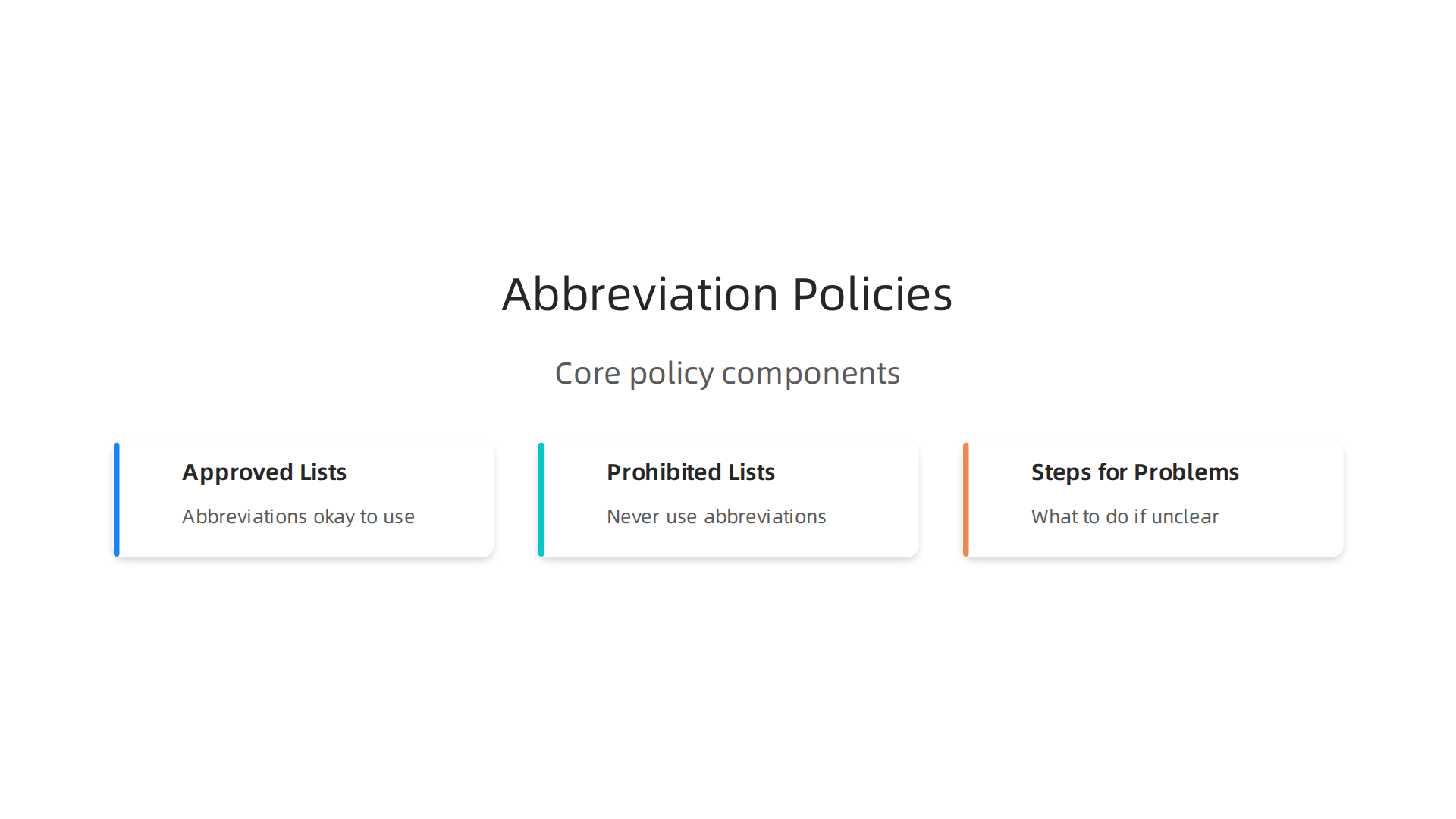
- Approved Lists: A list of abbreviations that are okay to use. These should be well-known and have only one clear meaning in that healthcare setting.
- Prohibited Lists: A list of abbreviations that should never be used because they cause confusion or lead to mistakes. For instance, some abbreviations can be misunderstood by different groups of healthcare workers, leading to errors in patient care Interpretation and Misinterpretation of Medical Abbreviations Found in ….
- Steps for Problems: What to do if someone sees an abbreviation they don’t understand. There should be a clear way to ask for help or fix the problem right away. This is often called an "escalation pathway." If a coder finds an unclear abbreviation, they should ask the provider for more information Mastering Medical Abbreviations for Accurate Coding.
Training for Everyone: Clinicians and Coders
Even the best policies won’t work without good training. Training needs to happen all the time, not just once.
- Regular Audits: Healthcare groups should regularly check patient records to see how abbreviations are being used. This helps find common mistakes or unclear uses.
- Feedback Loops: When mistakes are found, staff need to be told about them in a helpful way. This feedback helps people learn and do better next time.
- Training for Different Jobs: Doctors, nurses, and medical coders all have different jobs, so their training should match what they do. For example, coders need special training to handle unclear information and use the right codes Strategies and Challenges in Coding Ambiguous Information …. People working in medical assistant roles also need solid training on proper documentation from the start. Learn more about how to develop skilled healthcare professionals through a Medical Assistant Training Program.
By putting clear policies in place and making sure everyone gets the right training, healthcare can become much safer and more efficient in 2026. This also helps with legal protection and correct billing, making sure healthcare workers are supported and patients get the best care.
Want to stay informed about the latest tech that’s changing healthcare? Discover how AI and other innovations are shaping the future of medicine.
The AI Newsletter Worth Reading
Building on strong policies and training, technology offers powerful new ways to prevent errors from unclear abbreviations. In 2026, tools like Clinical Decision Support (CDS) and Natural Language Processing (NLP) are becoming key players in making patient records safer and clearer.
Using clinical decision support and natural language processing to expand and clarify abbreviations
Clinical Decision Support systems are like smart assistants for doctors. These computer programs give helpful advice right when a doctor is typing notes or orders. For example, if a doctor types "ROSC medical abbreviation" in a patient’s chart, a CDS system could pop up a message asking them to spell out "Return of Spontaneous Circulation" to prevent any confusion. These systems can also warn against using abbreviations that are known to cause mistakes. Studies have shown that computerized alerts can significantly reduce the use of error-prone abbreviations in progress notes Effectiveness of computerized alerts to reduce the use of error-prone abbreviations.
Natural Language Processing, or NLP, is a type of Artificial Intelligence (AI) that helps computers understand human language. In healthcare, NLP tools can scan patient notes and records to find abbreviations. If an NLP system finds an unclear abbreviation, like "bph abbreviation medical" (which could mean benign prostatic hypertrophy or something else) or "medical qhs abbreviation" (meaning every night, but sometimes confused), it can flag it for review or even suggest the correct full term. This auto-expansion feature helps make sure everyone understands the notes properly, which has been shown to reduce abbreviation use in electronic letters Auto-expansion software prompting reduces abbreviation use.
Using these smart tools comes with a few important things to think about:
- Accuracy: The systems must be very good at spotting and changing abbreviations without making new mistakes. If they are not accurate, they can create new problems instead of solving old ones. Special detector tools can find unapproved abbreviations in electronic medical records Detecting unapproved abbreviations in the electronic medical record.
- Clinician Workflow: These tools should fit smoothly into how doctors and nurses already work. They should make tasks easier, not harder or slower. A good system reduces the burden, not increases it.
- Evaluation: It is important to regularly check if these systems are actually helping to reduce errors and improve patient safety. This means looking at how often bad abbreviations are used and how clearly medical information is shared. Overall, a comprehensive approach can significantly reduce unsafe abbreviation usage Intervention to reduce the use of unsafe abbreviations.
By using CDS and NLP, healthcare providers can build an even stronger defense against the dangers of unclear medical abbreviations. These technologies help ensure that important health information is always understood correctly, which improves overall patient care and contributes to better social health: definition for communities.
Want to keep up with how AI is changing healthcare and making things like medical records smarter?
The AI Newsletter Worth Reading
Summary
Medical abbreviations speed communication in busy clinical settings but also create real patient safety, coding, and legal risks when they’re unclear or ambiguous. This article explains the difference between useful, well-understood terms like ROSC (Return of Spontaneous Circulation) and error-prone shortcuts that appear on