


Introduction
Have you ever spent hours in a waiting room for a five minute checkup that could have happened at home? Or watched a family member struggle to manage their health between scattered doctor visits?
You are not alone. This frustrating, fragmented experience is exactly what the healthcare industry is trying to leave behind in 2026.
The way we think about care is changing fast. For decades, healthcare meant going to a hospital or clinic when something went wrong. You waited until you got sick, then you got treated. That model is called episodic care. It is reactive, expensive, and often inconvenient.
But a massive shift is happening right now. Care is moving out of facilities and into homes. It is becoming continuous instead of episodic. And it puts you, the patient, back in control.

Why home is where the care is
The numbers tell a clear story. The global home healthcare market was valued at roughly $473 billion in 2026 and is on track to reach over $848 billion by 2033, according to industry analysts at Coherent Market Insights. That is nearly double in less than a decade.
A big reason for this growth is technology. Digital health platforms now do things that seemed impossible just a few years ago. They connect remote monitoring devices, care coordination tools, and patient engagement features all in one place. The global digital health market is projected to grow from $491 billion in 2026 to over $2.3 trillion by 2034, as reported by Fortune Business Insights.
In fact, the smart home healthcare segment alone hit $35 billion in 2026, and it is growing at over 18% each year, according to data from Mordor Intelligence shared via GlobeNewswire.
These tools are not just gadgets. They are changing how care actually works.
What is freedom care?
This is where the idea of "freedom care" comes in. Freedom care is about giving you more choice and more control over your health journey.
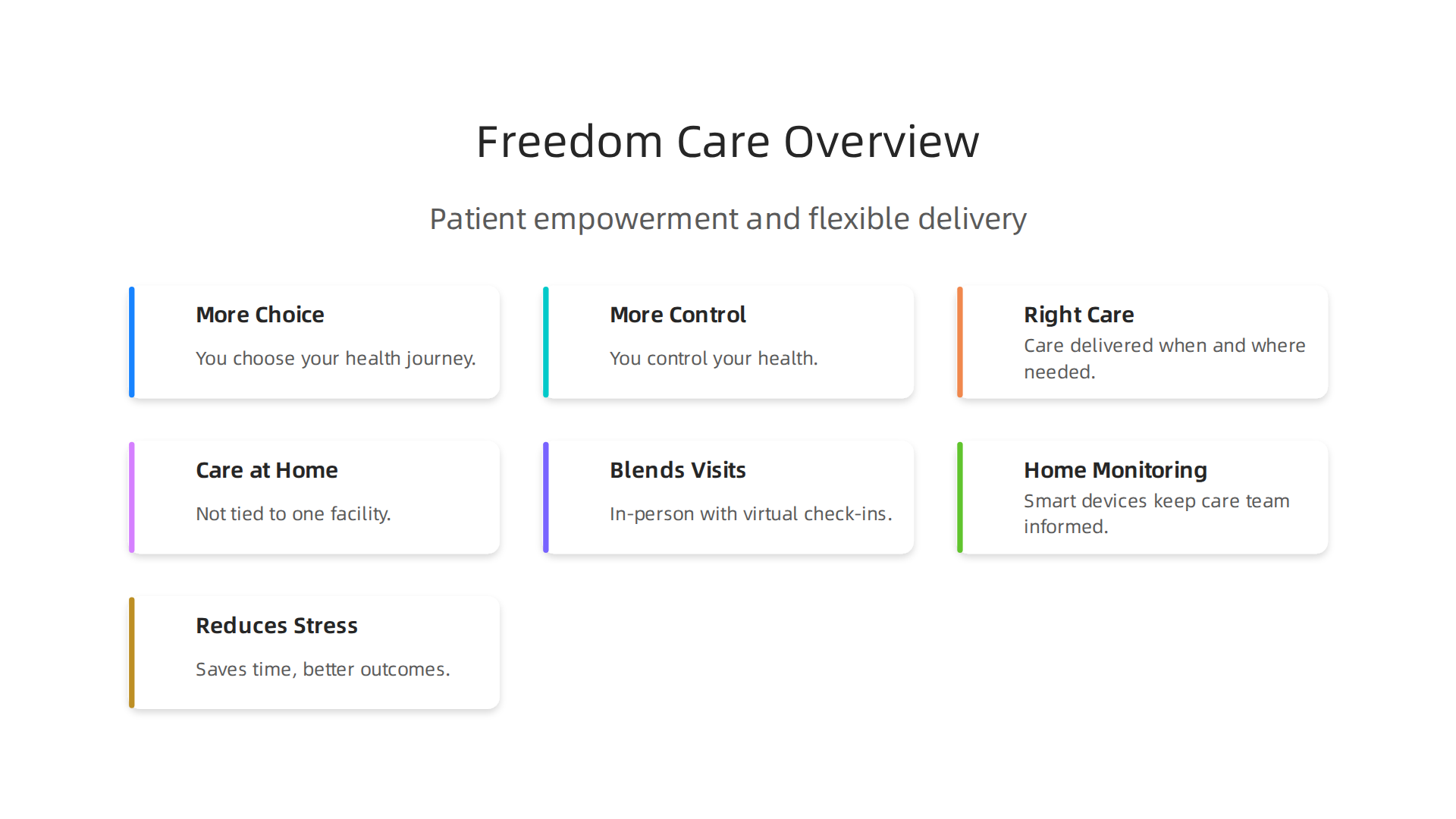
It means getting the right care at the right time in the right place, whether that is your living room, your workplace, or a clinic down the street.
Instead of being tied to one facility or one doctor’s schedule, freedom care lets care come to you. It blends in person visits with virtual check ins, home monitoring, and smart devices that keep your care team informed without you having to leave your couch.
This approach is especially powerful for older adults and people managing long term conditions. It reduces stress, saves time, and often leads to better outcomes. If you want to see how these new models are taking shape, check out our look at innovative primary care tech for seniors in 2026.
What this article covers
In this article, we will walk through what freedom care really looks like in practice. We will cover the technologies making it possible, the challenges that still exist, and what you need to know as a patient, caregiver, or healthcare professional.
The healthcare system is changing faster than most people realize. And the best part is that these changes are putting you first.
Ready to see the full picture? The AI space is moving just as fast, and staying informed is half the battle. For daily, to the point updates on AI and tech shifts that impact healthcare, subscribe to The Deep View Newsletter. It is the quickest way to keep your finger on the pulse without drowning in noise.
The Evolution of Home and Coordinated Care
Telehealth was the first big step. Remember the early days of pandemic lockdowns when you suddenly could see a doctor from your kitchen table? That was groundbreaking. But in 2026, simple video visits are just the starting point.
The real leap is happening now. Today’s platforms do not just connect you to a doctor on a screen. They weave together remote patient monitoring (RPM), artificial intelligence, and care coordination into one seamless experience. The home healthcare software market alone hit $9.73 billion in 2026, and analysts expect it to reach $15.12 billion by 2030, according to the Home Healthcare Software Market Report. That growth signals a major shift in how care is delivered.
From reactive visits to continuous care
Here is the thing: the old model was built on waiting. You waited for symptoms. You waited for an appointment. You waited for results. It was reactive, fragmented, and exhausting.
The new model is different. It uses connected devices that track your vital signs at home. It applies AI to spot problems before they become emergencies. And it coordinates your care team so everyone knows what is happening in real time. The FDA is even backing this shift with its Home as a Health Care Hub initiative, which encourages treating the home as an integral part of the healthcare system.
This matters especially for elder care services. A systematic review of 25 randomized controlled trials involving over 17,500 older adults found that home-based interventions improve clinical outcomes and patient reported experiences.

You can read the full findings in this study. The evidence is clear: care works better when it meets people where they live.
The business case for change
Why are health systems and insurers pushing this so hard? Money.
The healthcare industry is moving from fee-for-service to value-based care. Instead of getting paid for each visit or test, providers get paid for keeping you healthy. That changes everything. A randomized clinical trial published in JAMA found that care coordination programs for high need, high cost patients can reduce acute care use and lower overall costs.
Freedom care aligns perfectly with this model. When patients can monitor their conditions at home, share data automatically with their carenet health providers, and get virtual check ins between visits, the whole system runs smoother. Fewer ER trips. Fewer hospital readmissions. Better quality of life.
What freedom care looks like in practice
Think of freedom care less as a product and more as a philosophy. It puts you in control of your health journey with technology as your support system. Instead of fitting your life around doctor visits, care bends to fit your schedule.
For example, a platform that combines RPM devices with AI analysis can alert your nurse if your blood pressure spikes at 2 AM. You do not need to wait until morning. The intervention happens when it matters most. This kind of proactive, continuous care is what the future healthcare system is building toward.
If you want to see how these models are being applied specifically for older adults, check out our guide on innovative primary care tech for seniors in 2026. It covers real world examples of platforms that are already making this shift happen.
The bottom line: We have moved past the question of whether home based care works. We are now in the phase where we are figuring out how to scale it for everyone.
And the pace of change is only accelerating. To stay on top of the latest breakthroughs in AI and health tech that are driving this evolution, subscribe to The Deep View Newsletter. It delivers daily, digestible updates so you never miss what matters.
Core Capabilities of Modern Digital Health Platforms
So what does a modern digital health platform actually need to do to make freedom care possible? It comes down to three core capabilities that work together behind the scenes.
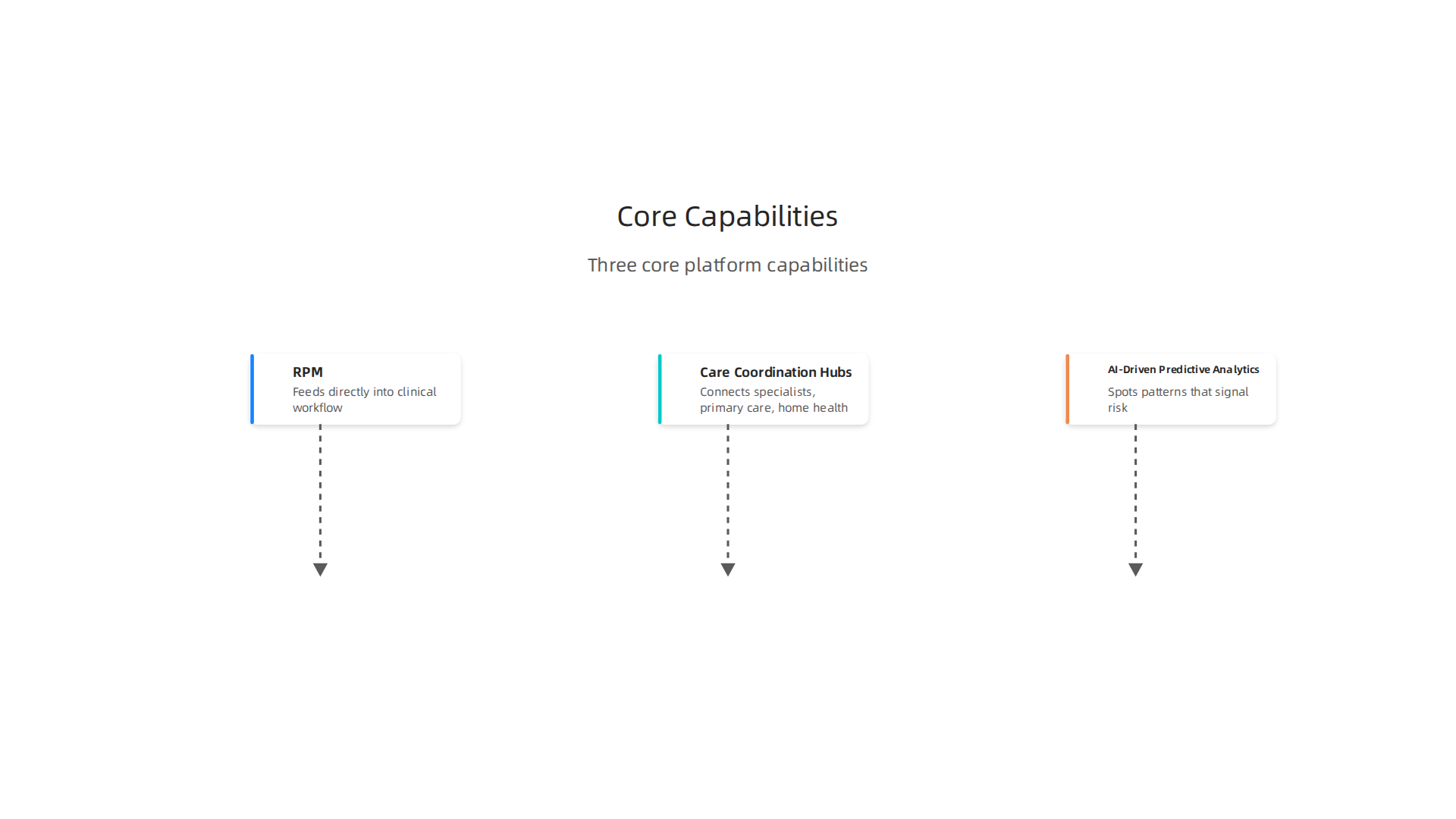
When these pieces are in place, care feels less like a chore and more like a safety net. Let us walk through each one.
Remote patient monitoring (RPM) that talks to your care team
RPM is not new. But in 2026, the big difference is integration. Your blood pressure cuff, glucose monitor, or pulse oximeter no longer sends data into a black hole. It feeds directly into the clinical workflow that your doctor, nurse, or home health aide uses every day.
When RPM data lands inside the same electronic health record (EHR) system that your care team already depends on, two things happen. First, alerts reach the right person immediately.

No waiting for a fax or a phone call. Second, the data helps prevent hospital readmissions. A large systematic review found that home-based interventions improved outcomes for over 17,500 older adults, and that kind of evidence is driving adoption in elder care services across the country.
The secret sauce here is interoperability. Platforms that use modern standards like FHIR (Fast Healthcare Interoperability Resources) can share data smoothly between devices, EHRs, and dashboards. The 2026 ISA Reference Edition from the Office of the National Coordinator for Health IT now defines best practices for FHIR-based data exchange, making it easier for systems to talk to each other. This matters because without clean data flow, RPM becomes just another gadget. With it, RPM becomes a lifeline.
For a deeper look at how these connections are changing primary care, check out our guide on digital health in family practice reshaping community care. It shows how smaller clinics are adopting RPM tools that plug straight into their existing workflows.
Care coordination hubs that connect everyone in real time
Here is the thing about old school healthcare: everyone worked in silos. Your primary care doctor did not know what the specialist told you. The home health aide did not see the hospital discharge notes. The pharmacist guessed at medication changes.
Modern digital health platforms fix this with care coordination hubs. These are central nervous systems that connect specialists, primary care doctors, home health teams, and even family caregivers in one shared view. When a patient is discharged from the hospital, the platform alerts the home care nurse, sends the updated medication list to the pharmacist, and notifies the primary care office for a follow up appointment. All in minutes.
This kind of real time coordination is what carenet health organizations are building toward. It turns fragmented handoffs into a smooth chain of communication. And it works. A randomized clinical trial published in JAMA showed that care coordination programs for high need, high cost patients can reduce acute care use and lower overall costs. That is a win for both patients and the system.
But coordination only works if the data is reliable. Platforms must comply with strict interoperability standards. The move toward mandatory FHIR compliance in 2026 means that more systems are finally speaking the same language. However, challenges remain, such as legacy system incompatibility and vendor lock-in, as explained in this breakdown of interoperability challenges. The platforms that overcome these hurdles deliver the kind of seamless experience that freedom care demands.
AI-driven predictive analytics that spot trouble early
The third capability is the one that feels like magic, but it is actually just smart math. AI driven predictive analytics take all the data from RPM devices, care coordination logs, and historical health records, then look for patterns that signal risk.
For example, the system might notice that a patient with heart failure has gained three pounds overnight and their blood pressure is trending upward. Before the patient even feels short of breath, the platform alerts the care team. A nurse calls to adjust the diuretic dose or schedule a virtual check in. The emergency room visit never happens.
This proactive approach is the heart of freedom care. Instead of waiting for a crisis, the system intervenes early. A scoping review on value based healthcare implementation found that predictive analytics are a key enabler for improving outcomes while controlling costs. That is exactly the kind of trade off that health systems need.
The point of care shifts from the hospital to the home, and the timing shifts from reactive to preemptive. This is the future healthcare model that everyone is chasing, and it is already working in pilot programs across the country.
The big picture
When RPM, care coordination, and AI predictive analytics work together, they create a digital health platform that does not just manage disease. It helps people stay healthy longer, in their own homes, with less stress and fewer surprises.
These capabilities are evolving fast. New standards, new devices, and new algorithms are emerging every month. To keep up with the breakthroughs that matter most, subscribe to The Deep View Newsletter. It delivers daily, clear updates on the AI and health tech trends that are shaping the future of care.
Strategic Value for Healthcare Executives and Investors
You have seen how RPM, care coordination hubs, and AI analytics work together. That is exciting technology. But if you are a healthcare executive or an investor, you need to know one thing: does it actually move the needle on costs, revenue, and growth? The short answer is yes.

Here is the strategic case for putting your weight behind freedom care platforms in 2026.
Lower total cost of care by shifting to the home
Hospitals are expensive. Every day a patient spends in a bed costs thousands of dollars. Home care flips that math. When you move monitoring, follow ups, and even acute level care into the patient’s living room, the cost per episode drops significantly.
In fact, CMS finalized a 1.3 percent reduction in aggregate Medicare payments to home health agencies for 2026. That puts pressure on agencies to operate leaner. The agencies that survive and thrive are the ones using digital platforms to reduce waste and improve efficiency. A detailed guide on evaluating home care software ROI shows that proper EHR integration and EVV compliance can make agencies profitable even under tighter margins.
The numbers back this up. A remote patient monitoring ROI analysis found that a 200 patient RPM program can generate $144,000 to $204,000 in annual revenue, with a break even point within two months. That kind of return makes home care a smart investment for health systems looking to lower their total cost of care while keeping quality high.
Investment dollars are flowing into home care
The market is voting with its wallet. According to the top home care trends report for 2026, home care remains one of the hottest sub sectors in digital health. Investors see that demand is not the problem. Capacity is. The home based care industry is struggling to scale fast enough to meet the wave of aging baby boomers who want to age in place.
For executives, this means there is a clear window to build or acquire platforms that solve the capacity bottleneck. For investors, it means funding companies that offer scalable, interoperable solutions that plug into existing health system workflows. The platforms that win will be the ones that help agencies hire, schedule, and retain staff more effectively.
Platforms that use data well can also unlock completely new revenue streams. When you have a steady flow of RPM data and care coordination logs, you can offer de identified data sets to research organizations, pharmaceutical companies, and population health managers. You can also build value based contracts with payers that reward outcomes instead of volume. That is the kind of future healthcare model that turns a cost center into a profit center.
Take the Bloom program from Sword Health. It delivers a 3.6x gross ROI and saves $3,082 per member per year on pelvic related healthcare. That is a concrete example of how a focused digital health intervention creates measurable value for both the patient and the bottom line.
The bottom line for leaders
Home care platforms are not just nice to have. In 2026, they are a strategic necessity. They reduce costs, attract investment, and open up new revenue opportunities. The shift to value based care is accelerating, and freedom care is the vehicle that gets you there.
If you are serious about staying ahead of these trends, you need reliable daily intelligence. The health tech landscape changes fast. Don’t get caught relying on outdated data. Subscribe to The Deep View Newsletter for clear, daily updates on the AI and health tech breakthroughs that matter most to your strategy.
Regulatory Landscape and Compliance for Home Care Platforms
All that strategic value we just talked about? It only works if your platform is built on a solid legal foundation. The regulatory world for home care technology is changing fast in 2026. And if you ignore it, you risk fines, shutdowns, or worse.
Here is what you need to know about the rules that govern platforms enabling freedom care across borders.
Data privacy is the starting line
HIPAA in the United States and GDPR in Europe are the bedrock rules for any platform handling patient data. They are non-negotiable. If your system collects vital signs, medication records, or video visit logs from patients in multiple countries, you need compliance on both sides. That means strong encryption, strict access controls, and clear patient consent workflows.
The FDA’s Digital Health Center of Excellence provides a central hub for understanding how these requirements overlap with device regulation. And if you are operating in Texas, the Texas Medical Board regulations for 2026 add another layer of state level requirements every health tech company must follow.
When your software becomes a medical device
Here is where things get tricky. Many RPM platforms and AI analytics tools fall under Software as a Medical Device, or SaMD. That means FDA clearance or CE marking may be required.
The good news? The FDA has been working to make this easier. In January 2026, the agency updated its guidance on General Wellness and Clinical Decision Support Software, loosening the rules for certain low risk digital health tools. That includes many wearables and lifestyle tracking apps that support point of care decisions without needing full premarket approval.
But do not assume your product is exempt. The FDA’s Home as a Health Care Hub initiative is actively exploring how to regulate devices used outside traditional clinical settings. If your platform helps diagnose, triage, or recommend treatment, you should review the FDA’s guidances with digital health content early in development.
A law firm analysis of the updated guidance expanded the scope of digital health tools, including certain types of clinical decision support software. That means more products are now under the FDA umbrella, not fewer.
AI regulation is still evolving
If your platform uses machine learning to predict patient deterioration, recommend care plans, or adjust medication doses, you are in a gray zone. The FDA has not fully settled how to regulate AI models that learn and change over time.
The agency’s Digital Health Center of Excellence is working on frameworks for AI/ML based devices, but final guidance is still pending in many areas. For now, the safest path is to design your AI components to be locked on deployment, with manual oversight for any updates.
You can find answers to common regulatory questions on the Fenwick FAQ page. It covers how to classify your product and when to engage the FDA early.
The bottom line for builders and buyers
Compliance is not a checkbox. It is a design constraint that makes your platform stronger. The platforms that treat HIPAA, GDPR, and FDA requirements as core features, not afterthoughts, will win trust from health systems and patients alike.
These regulations shift every year. To stay ahead of changes that affect your future healthcare strategy, you need clear, daily intelligence. Subscribe to The Deep View Newsletter for practical updates on health tech regulation and innovation.
Implementation Challenges and Best Practices
So you have the regulatory piece handled. Now comes the hard part: making it all work in the real world. Building a platform that enables freedom care for patients is one thing. Getting it to actually be used by busy clinicians and integrated into messy hospital systems is another.
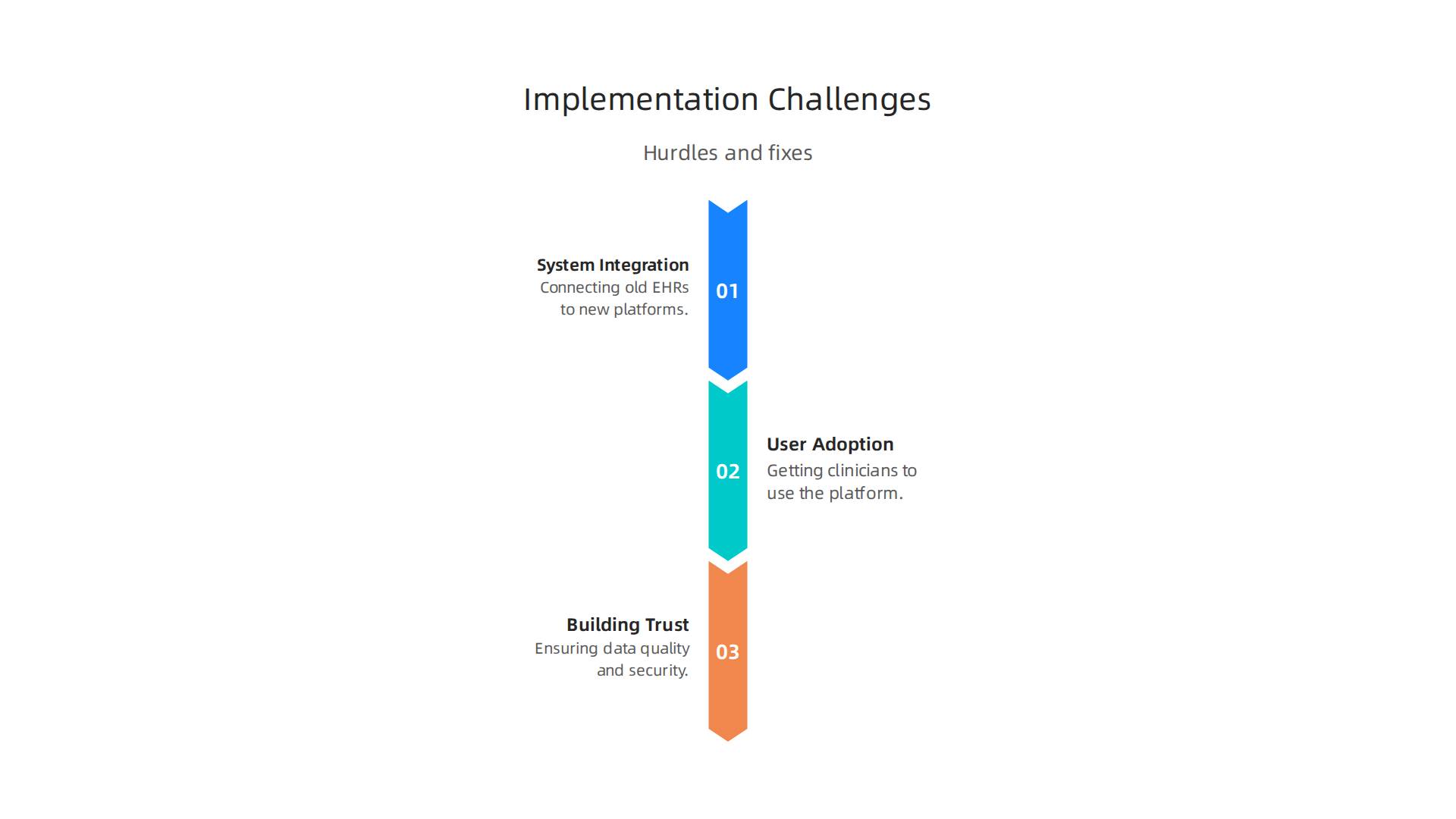
Here are the biggest hurdles and how to overcome them.
Getting old systems to talk to new ones
The number one technical obstacle is connecting your shiny new platform to a hospital’s existing electronic health record (EHR). Many hospitals still run on outdated systems that were never designed to share data. That is where FHIR, or Fast Healthcare Interoperability Resources, comes in.
In 2026, FHIR compliance is no longer optional. According to a 2026 report on interoperability, "FHIR compliance is now an operational requirement" for any practice that wants to share patient data smoothly. But even FHIR has its challenges. Inconsistent data standards, vendor lock-in, and legacy system incompatibility are still the top barriers to true interoperability.
A complete implementation guide on FHIR API integration highlights that real-world success requires treating FHIR endpoints as "first class citizens" with proper security, rate limiting, and monitoring. Without that careful approach, your data pipeline will break or leak.
Getting people to actually use the platform
Here is a hard truth: the best technology in the world is useless if no one uses it. User adoption is not a technical problem, it is a people problem. Clinicians are already overwhelmed. Asking them to learn yet another system will fail unless you make it worth their while.
The key is thoughtful change management. Engage clinicians early in the design process. Show them how your platform saves them time, not adds to their load. For example, a platform that supports elder care services can automatically log vitals and medication changes, freeing up nurses to spend more time with patients.
Training should be hands on and ongoing. Celebrate early wins and let power users become champions. This is especially important for platforms that connect point of care decisions in the home. If a home health aide cannot figure out the interface, they will just ignore it.
You can see how these adoption principles are already reshaping senior care in this article on innovative primary care tech for 2026.
Building trust through data quality and security
Even if your platform integrates perfectly and people want to use it, one data leak can destroy everything. Security must be baked in from day one, not patched on later.
Data quality matters just as much as security. If the data coming from wearables or patient logs is messy, your AI tools will make bad recommendations. That hurts trust. Implement clear data governance rules from the start.
For platforms focused on future healthcare that spans multiple providers and settings, encryption must cover data at rest and in transit. Access controls should be role based, and every data exchange should be audited.
The roadmap for EHR interoperability in 2026 from Certify Health emphasizes a phased strategy: start with a pilot, prove the value, then expand. That same approach works for security and quality controls.
The bottom line
Implementation is hard. But if you tackle integration, adoption, and data quality step by step, your platform becomes the backbone of real freedom care.
To stay ahead of the latest health tech implementation strategies, get clear daily updates from The Deep View Newsletter. It covers the trends and tools that matter for your future healthcare strategy.
Future Outlook: What’s Next for Home and Coordinated Care?
The shift from hospital rooms to living rooms is not slowing down. It is speeding up.
By 2026, the global home healthcare market is already worth $473 billion, and experts predict it will reach $848 billion by 2033. The digital health market is even bigger, projected to hit $491 billion in 2026 alone. What does that mean for you? The future of freedom care is being built right now.
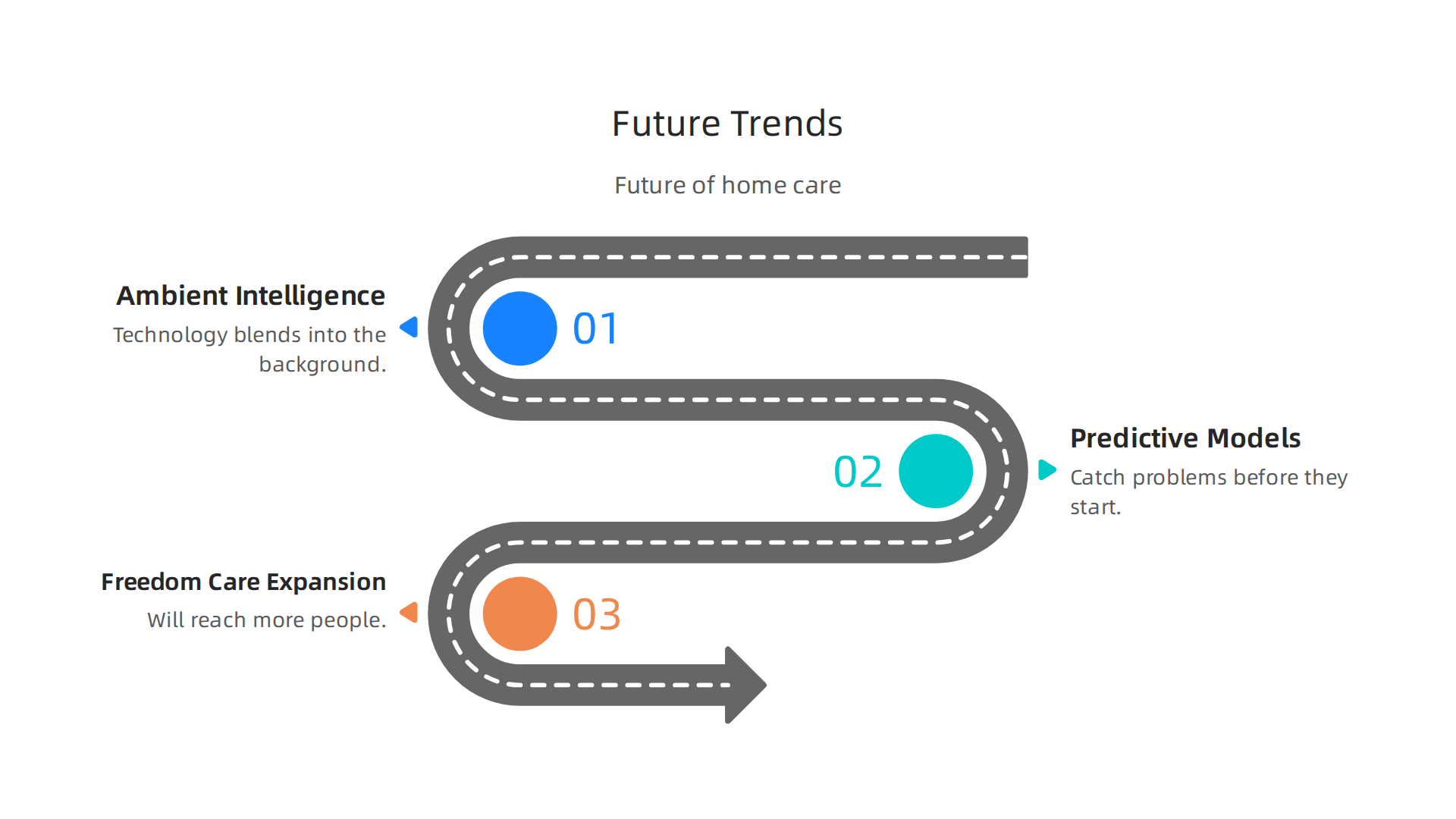
Ambient intelligence will make care invisible
Here is the big idea. Instead of asking patients to wear clunky devices or log symptoms manually, the technology will just blend into the background. Think of smart speakers that listen for coughing at night. Or motion sensors that detect if someone has not left the bathroom in a while. This is called ambient intelligence.
Passive monitoring reduces the burden on patients, especially seniors who want to age in place. They do not have to remember to push buttons or charge wearables. The system learns what is normal and alerts caregivers only when something changes. The smart home healthcare market alone is expected to hit $35.4 billion in 2026, driven by these kinds of tools.
Predictive models will catch problems before they start
Most healthcare today is reactive. You feel sick, you go to the doctor. But with better data from home monitoring, AI can spot trends early. A predictive model might notice that Mrs. Jones has been sleeping two hours longer each night for three days. That could signal an upcoming infection or a medication side effect.
This shift toward proactive population health management is already happening. The global digital health market is growing at over 21% each year, and a big piece of that is analytics that help providers intervene early. For example, platforms that support elder care services can use vitals and activity data to flag risk before a crisis happens.
Want to see how these proactive models are reshaping senior care right now? Check out this breakdown of innovative primary care tech for 2026.
Freedom care will reach more people
The idea of freedom care started with letting patients recover at home instead of in a hospital. But in 2026, the concept is expanding fast. It now covers mental health support through virtual therapy. It includes chronic disease management for diabetes, heart failure, and COPD. And it is the backbone of aging in place for millions of seniors.
What makes this all possible is better coordination across providers. When a home health aide, a primary care doctor, and a specialist can all see the same data, care gets smoother. That is where point of care decisions start happening in the home, not just in clinics.
The home health software market is growing at 11.6% CAGR, and agencies are adopting new tools to handle everything from scheduling to compliance. But the real opportunity is giving patients more control over their own health.
The bottom line
The next few years will bring huge changes to home and coordinated care. Ambient intelligence will make monitoring effortless. Predictive models will stop crises before they start. And freedom care will become the standard for mental health, chronic disease, and aging in place.
To stay on top of these trends and know what is coming next, get daily insights straight to your inbox. The Deep View Newsletter covers the most important shifts in health tech, AI, and digital health every day.
Summary
This article explains the rise of