


Introduction
Public health research examines patterns of health and ways to protect or improve health across groups of people. Its questions can involve disease, behavior, services, environments, or policies, and may focus on a community or population as well as individuals within it. The field brings together different kinds of evidence to help explain what is happening, who is affected, and which responses merit further evaluation.
This guide covers common public health research designs, from observational studies to intervention evaluations, and explains what each can and cannot show. It also outlines how researchers select methods, address ethics and equity, and set priorities. Those priorities depend on the needs of particular populations and the agendas of organizations and public health authorities; they are not a single universal list. Readers can use these distinctions to judge what a study can support, what remains uncertain, and why findings may not transfer unchanged between settings.
What Is Public Health Research?
For this guide, public health research means investigating health questions with attention to patterns and conditions that affect groups, communities, or populations. It can help identify needs, examine possible causes of health differences, evaluate interventions, and inform decisions in policy or practice. This is a practical description, not a formal definition that applies identically across every discipline or jurisdiction.
The focus does not mean that research excludes individuals. Researchers may collect information from individuals to understand a wider pattern, or study how services and systems shape health. A useful distinction is the question being asked: clinical research often centers on diagnosis, treatment, or outcomes for a person, while a population-focused question may ask how a condition is distributed across groups or how a policy affects access to care. These areas can overlap, and neither label alone determines a study’s purpose.
Public health research may draw on clinical, behavioral, social, environmental, and health-systems perspectives. For example, a study might examine health behaviors, explore how local conditions relate to exposure, or assess whether a program is reaching the people it intends to serve. The appropriate perspective depends on the question and the evidence needed to address it.
Common Public Health Research Study Designs
Study design shapes what researchers can learn from their data.
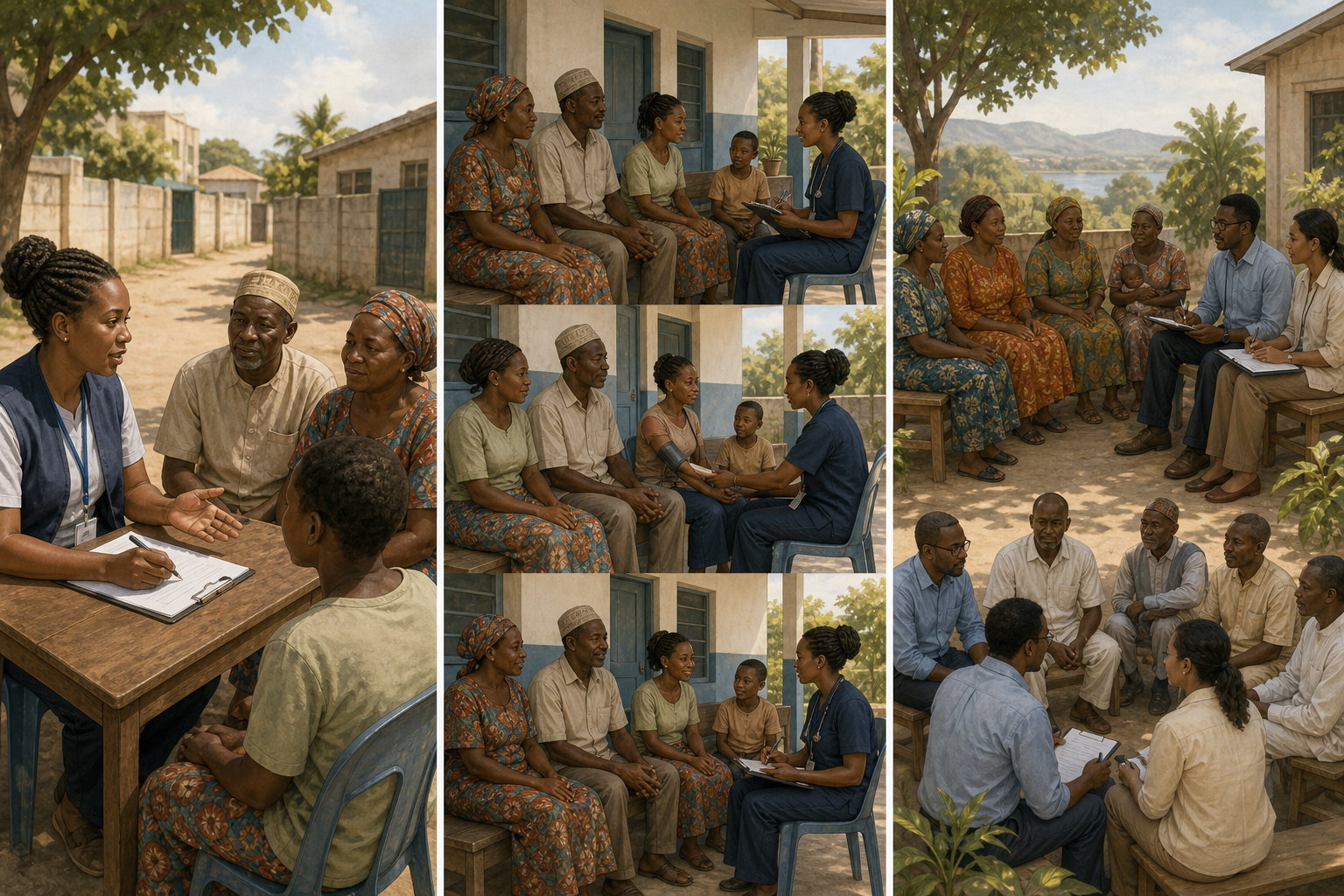
Observational studies examine exposures, outcomes, or other characteristics without assigning participants to an intervention. CDC-hosted STROBE reporting guidance addresses cohort, case-control, and cross-sectional studies and highlights details readers need to assess a report, including participant selection, measurement, bias-reduction efforts, missing data, and sensitivity analyses. Reporting guidance helps readers evaluate a study; it does not remove bias or establish causality.
| Design | Questions it can address | Typical strength | Key limitation |
|---|---|---|---|
| Cross-sectional | How are exposures or outcomes distributed in the studied group? | Can describe patterns using information collected at the same time. | Simultaneous measurement can limit interpretation of which came first; confounding and reverse causality may also complicate interpretation. |
| Cohort | How do outcomes vary over time among groups defined by exposure or other characteristics? | Can help examine the sequence of exposure and outcome. | Temporal sequence alone does not establish causation; confounding, selection, measurement, and analysis matter. |
| Case-control | Is an exposure associated with an outcome or condition? | Can investigate associations by comparing people with and without an outcome. | The available guidance supports this use but does not establish that this design is especially efficient for rare outcomes. |
| Experimental | What happens when an intervention is evaluated in a controlled study? | Can assess an intervention under planned comparison conditions. | Feasibility and ethics may limit whether a controlled experiment can be conducted. |
| Quasi-experimental | What effect may an intervention or policy have without individual randomization? | Can evaluate policies or interventions using nonrandomized comparisons, such as before-and-after or time-series designs. | Estimates depend on assumptions and careful control of confounding; designs do not automatically establish causal effects. |
| Qualitative or mixed methods | How do people experience a program, and what context may help explain observed patterns? | Qualitative information can add lived experience and context; mixed methods can combine quantitative breadth with qualitative depth. | Mixed methods require a reasoned plan for collecting, analyzing, and integrating both forms of evidence. |
A methodological review of cross-sectional designs notes that measuring exposure and outcome at the same time can limit temporal interpretation and may leave confounding or reverse causality unresolved. The same source describes quasi-experimental approaches, including controlled before-and-after and interrupted time-series designs, while emphasizing the need to consider validity threats. When controlled or quasi-experimental research is impractical, an observational study may be the available option, but that does not make its causal evidence equivalent.
Qualitative and mixed-methods approaches can address questions that numbers alone may not capture, including context and lived experience. NIH mixed-methods guidance recommends using the approach when study aims warrant it and explaining how the data will be integrated. No design is best for every question: choice depends on the question, feasibility, ethics, and available data.
Methods: From Research Question to Evidence
A study’s methods make its question testable. Researchers specify who or what is being studied, the setting, the exposures or interventions of interest, the outcomes to measure, and any comparison groups. Clear definitions help readers understand what the findings do and do not represent. Researchers also explain how key concepts are translated into measurable variables and whether the chosen measures fit the question.
Data may come from surveys, administrative records, public health surveillance, interviews, or environmental measurements. Each source captures different information and can have gaps. Researchers should explain how participants or records were selected, how variables were measured, and what steps were taken to address potential bias. They may also describe how data were collected consistently across participants or settings, and whether some groups or records are missing. CDC-hosted STROBE reporting guidance recommends reporting these details for observational studies, along with study size, missing-data handling, and sensitivity analyses. Reporting guidance helps readers assess a study; it does not remove bias or establish causality.
Quantitative analysis works with numerical data to describe patterns or estimate relationships. Qualitative analysis examines accounts and observations to understand perspectives and context. These approaches can address different parts of a question, but qualitative methods are not automatically preferable for every study. Mixed methods deliberately bring both forms of evidence together. For example, numerical patterns may describe the scale of an issue, while qualitative information can help explain experiences and local context. NIH guidance recommends using mixed methods when the research aims justify it, with a rationale for how the data will be collected, analyzed, and integrated, rather than simply adding interviews to a quantitative study.
Interpretation should make uncertainty visible. Reports need to describe missing information, design limitations, and possible alternative explanations. A finding from one setting or population may not apply in the same way elsewhere. Readers should consider the study’s sampling, measurements, context, and limitations before drawing conclusions.
How Researchers Choose a Study Design
Design choice starts with the question. Researchers may want to describe how common a condition or exposure is, examine an association, assess a policy or intervention, or understand people’s experiences. The design should fit the kind of evidence needed, not be chosen because one method is presumed best.
Feasibility matters too. Time, cost, data access, sample size, and the practical or ethical possibility of assigning an intervention can shape what is possible. CDC-hosted guidance notes that an observational study may be the only option when controlled or quasi-experimental research is impractical. That can make observational evidence useful, but it does not make it equivalent to evidence from a controlled experiment. Nonrandomized intervention studies also depend on their design assumptions and how carefully confounding is addressed.
For example, an illustrative scenario, not a real study: a researcher asking how frequently residents report a symptom might use a survey; one asking whether a policy is followed by a change over time might consider a time-series approach; and one asking how residents experience access to services might use interviews. These questions call for different evidence. NIH mixed-methods guidance recommends combining approaches when the aims warrant it and explaining how the findings will be integrated.
A useful decision pathway is: define the question, identify the evidence needed, check feasibility and ethics, then select a design and state its limits. For instance, cross-sectional measures collected at the same time can make temporal interpretation difficult, so an observed association alone should not be presented as proof that one factor caused another.
Ethics, Equity, and Community Considerations
Ethical planning includes how participants are informed, how privacy is protected, and how risks are minimized. In the U.S., the Belmont Report offers a foundational framework of respect for persons, beneficence, and justice. NIH materials connect these principles with informed consent, minimizing risks, and fair distribution of research burdens and benefits. Belmont is not a universal legal code; applicable requirements depend on jurisdiction, study details, and institutional review. NIH describes informed-consent requirements under the Common Rule for covered human-subjects research, but coverage and exceptions depend on the governing context.
Equity considerations begin with asking who is included, whose experiences may be missing, and how the findings describe differences in health. Sampling can affect which perspectives and conditions are represented, but it cannot by itself guarantee that results apply to everyone in a target population. Researchers should report who took part and acknowledge limits on applicability rather than treating a sample as universally representative.
Community involvement can help researchers understand local priorities and interpret findings in context. The NIH-supported Principles of Community Engagement presents partnerships as guidance for research and notes that methods may need to reflect both community perspectives and research aims. This is not a general Common Rule or Belmont mandate. Some funding opportunities set specific engagement conditions for particular contexts, so requirements should be checked directly. Clear, respectful reporting can also avoid reducing a community to a risk label or implying that observed differences reflect inherent traits rather than the circumstances studied.
Public Health Research Priority Topics in 2026
Public health research priorities reflect the needs of particular populations and places, along with disease burden, emerging risks, and the agendas of governments and funders. They are not a single universal ranking. The World Health Organization (WHO) describes its research agenda as addressing health needs, evidence gaps, emerging areas, and country priorities (WHO research overview).
Some priorities address longstanding public health challenges. India’s National Health Research Policy 2026 identifies major-burden topics including tuberculosis, antimicrobial resistance, mental health, noncommunicable diseases, maternal and child health, nutrition, primary care, and emergency care. It gives particular attention to vulnerable and underserved populations and geographies. These are priorities for India, not a ranking that applies everywhere.
Preparedness is also a formal research priority. WHO’s 2025 global agenda on public health and social measures during health emergencies, which runs through 2030, raises questions about how effective measures are, what shapes adherence, and what unintended health and socioeconomic consequences they may have (WHO agenda, published June 16, 2025).
WHO’s Global research prioritization and action plan on health, migration and displacement in the context of climate change: strengthening research and translating research priorities into policy and practice, published June 11, 2026, sets out a global agenda covering social determinants of health, universal health coverage, emergencies, and cross-cutting themes including data, policy, interventions, and health outcomes. It points to research questions about health-system access, climate-emergency preparedness, mental health, and long-term effects of climate-related mobility (WHO report). WHO reports participation from more than 75 countries, but that does not establish universal agreement.
India’s policy separately labels digital health, artificial intelligence, data science, cell and gene therapy, and climate change and health as emerging or frontier areas. Their inclusion identifies policy interest, not equal relevance or readiness for implementation.
Agendas reflect the issuing organization, date, and population or geographic scope. Treat them as evidence of stated priorities, not a universal consensus or ranking.
Turning Research Findings Into Public Health Action
Research findings can inform public health programs, policy choices, surveillance, or further studies. How they are used depends on the question, the quality and limits of the evidence, and whether the findings apply to the population and setting under consideration. One study rarely answers every practical question, and a result in one context does not by itself show that an intervention will work elsewhere.
Decision-makers can consider the study design, how information was collected, who was included, and whether other findings support the same interpretation. Qualitative evidence may add lived experience and context to quantitative patterns. An NIH-supported community-engaged framework, for example, describes combining quantitative breadth with qualitative depth in community health needs assessment; that example does not mean mixed methods are necessary for every decision (framework).
Community partnerships may also guide research, and NIH-supported guidance notes that mixed qualitative and quantitative methods may be useful for evaluating program effects and adoption or adaptation. These recommendations should be adapted to the population, setting, and research purpose (Principles of Community Engagement).
When evidence is incomplete or context-specific, a responsible next step may be to gather more data, adapt an approach, or evaluate it in the intended setting rather than treating an initial finding as a settled policy prescription.
Conclusion
Public health research connects population-health questions with study designs and methods suited to investigating them. Its findings are most useful when readers understand who was studied, how evidence was gathered, and what the design can—and cannot—support. Priorities also depend on place, population, and the agenda setting them. When assessing a study, check its methods and limitations before deciding how far its conclusions apply.
Start by identifying the question the study set out to answer, then check whether its participants, measures, and analysis fit that question. Consider whether the findings apply to the population or setting you care about, and separate reported results from interpretation.
Summary
Learn how public health research uses observational, experimental, quasi-experimental, qualitative, and mixed-methods designs to answer population health questions. The article explains method selection, interpretation limits, ethics and equity considerations, and why research priorities vary by population, place, and issuing organization.